The Thoroughbred Industry Doesn’t Have a Messaging Problem. It Has an Infrastructure Problem.
By the Light Up Racing Board of Directors, with Amy Brin, Interim Executive Director
Mature industries don’t simply launch successful initiatives.
They study them. They evaluate them. They absorb what works into permanent infrastructure. That is the opportunity now facing Thoroughbred racing.
Over the past two years, Light Up Racing has served as a pilot—testing new approaches to communications, collaboration, education, and public engagement. The value of a pilot, however, is not its permanence. Its value is what it reveals.
The most important lesson has little to do with communications. It has everything to do with infrastructure.
The Thoroughbred industry does not have a messaging problem. It has an infrastructure problem.
Communications campaigns raise awareness. Infrastructure earns trust. If the industry wants different outcomes, it should focus less on creating new initiatives and more on strengthening the systems that allow successful ideas to endure.
1. Fix Philanthropic Infrastructure
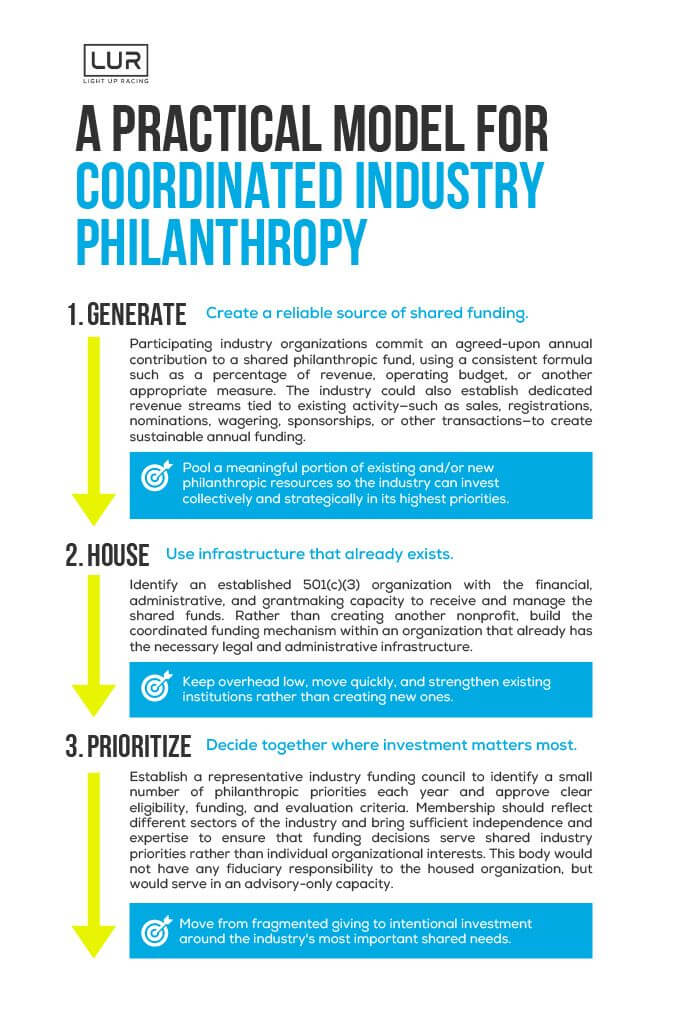
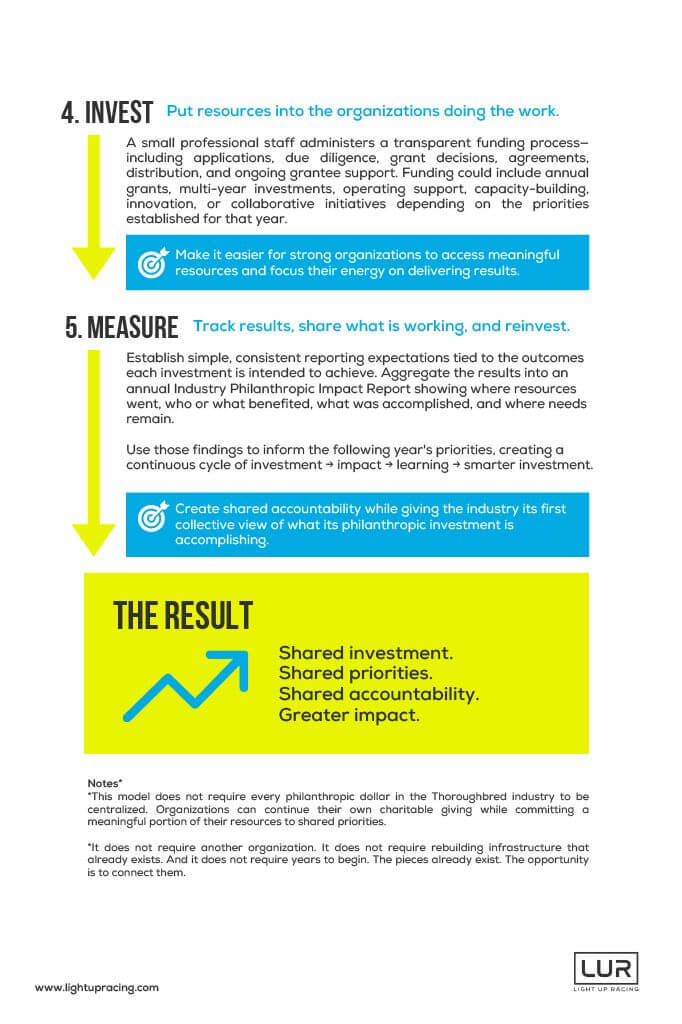
The industry’s funding priorities and funding practices are misaligned. Organizations advancing workforce development, public education, aftercare awareness, safety communications, and other industry-wide priorities continue to operate within a funding model that is inconsistent. Mature industries fund shared priorities through systems; not annual uncertainty.
Define funding priorities. Each philanthropic-funding organization should annually establish one to three strategic priorities, anticipated funding levels, and desired outcomes.
Standardize the process. Publish application requirements, submission deadlines, award timelines, reporting expectations, and funding criteria.
Increase multi-year investment. Dedicate a portion of annual giving to two- and threeyear commitments that allow organizations to build sustainable programs rather than restart every budget cycle.
Reduce duplication. Establish collaborative funding mechanisms for industry-wide priorities, reducing repetitive requests while encouraging coordinated investment.
Implementation Note: This work does not require creating a new charitable entity. Existing nonprofit infrastructure (501c3) can administer collaborative funding models by leveraging established governance, financial oversight, and administrative capacity.
2. Build Communications Infrastructure
The Thoroughbred industry has talented communicators. What it lacks is coordinated communications infrastructure. This is not a recommendation for centralized messaging. Individual organizations should continue communicating in ways that reflect their own missions, cultures, and audiences. The opportunity is coordination.
Assign ownership. Designate one existing industry organization to convene communications leaders and coordinate long-term infrastructure supporting education, public engagement, and trusted information.
Hold the owner accountable. Define success. Publish a strategic plan, annual priorities, and measurable outcomes so the function itself is accountable to the industry it serves.
Develop shared resources. Maintain an evidence-based library of educational content, messaging guidance, research summaries, and digital assets available across the industry. Build it off LUR’s existing online resource library.
Convene communicators. Regularly bring communications leaders together to identify emerging issues, share successful practices, and coordinate educational efforts.
Invest in capability. Continue developing industry ambassadors through media training, communications education, and grassroots engagement initiatives. Use LUR’s newly released virtual media training resources to build an ambassador pipeline.
Implementation Note: This function should be embedded within an existing national organization whose mission already includes advancing the long-term health of Thoroughbred racing.
3. Scale Success, Not Organizations
Innovation should create stronger institutions, not simply more institutions.
The Thoroughbred industry has consistently demonstrated innovation by launching new initiatives to address emerging challenges. What it has lacked is a scalable process for determining what happens after those initiatives succeed.
Too often, successful pilots become permanent organizations instead of permanent industry functions. Mature industries take a different approach. Successful innovation strengthens existing institutions whenever possible.
Define success before launch. Define the transition strategy. Before funding begins, identify where successful work will ultimately live if the pilot proves effective. Tie this to receipt of industry funding.
Evaluate independently. At predetermined milestones, assess whether the initiative achieved its intended outcomes and whether the work addresses a permanent industry need.
Decide deliberately. Successful pilots should not automatically become permanent organizations. Leaders should determine whether the work should conclude, merge into an existing organization, or become a permanent industry function.
Transition intentionally. If the work has proven value, develop a transition plan identifying the receiving organization, governance structure, funding model, staffing, and measures of success before pilot funding concludes.
Closing
These recommendations are practical. Many are cost-neutral. None require starting from scratch. Light Up Racing has done what every successful pilot should do: identify what works. The implementation frameworks exist – many are currently in the hands of industry executives. The next move belongs to industry leadership.